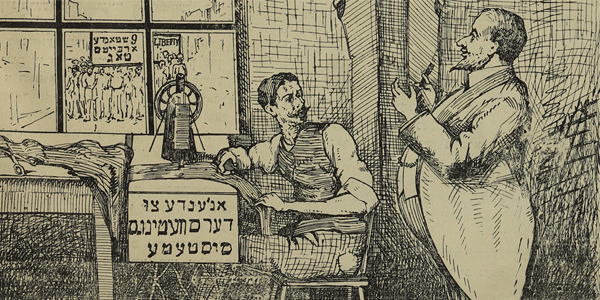
“The Tailors’ Victory in the Fight for a 9-Hour Working Week”
Scab (to master): What? No more than 9 hours’ work a day. Where will I get money to bet on the horses?
Master Tailor: Don’t worry, my friend. You’ll work 9 hours before lunch and 9 hours after lunch.
Protesters’ banner: “9 hours a working day”
Tailor’s table sign: “An end to the sweating system”
Der bloffer, 1912. From the collection of the National Library of Israel.
The East End of London has always been a place of political protest and activism and this episode focuses on East End Jewish radicalism. From the union protests of the 1880s through to fighting fascism in the 1936 Battle of Cable Street, Nadia and Vivi discuss Yiddish-speaking activists in East End politics with historians Professor Ruth Livesey and Dr Sarah Glynn. Join us in listening to Morris Winchevsky’s attempts to cajole Victorian Jewish workers into action with one of his Meshugener Filozof (Crazy Philosopher) columns, read by Nick Cassenbaum, and Winchevsky’s angry ballad ‘London bay nakht’ (London at Night). Join in singing stirring protest songs with the Great Yiddish Parade and the strike songs of the Rego-Polikoff factory women!
‘How Do You Become a Poet?’ (Vi vert men a dikhter?) (1889)
Morris Winchevsky, translated by Vivi Lachs
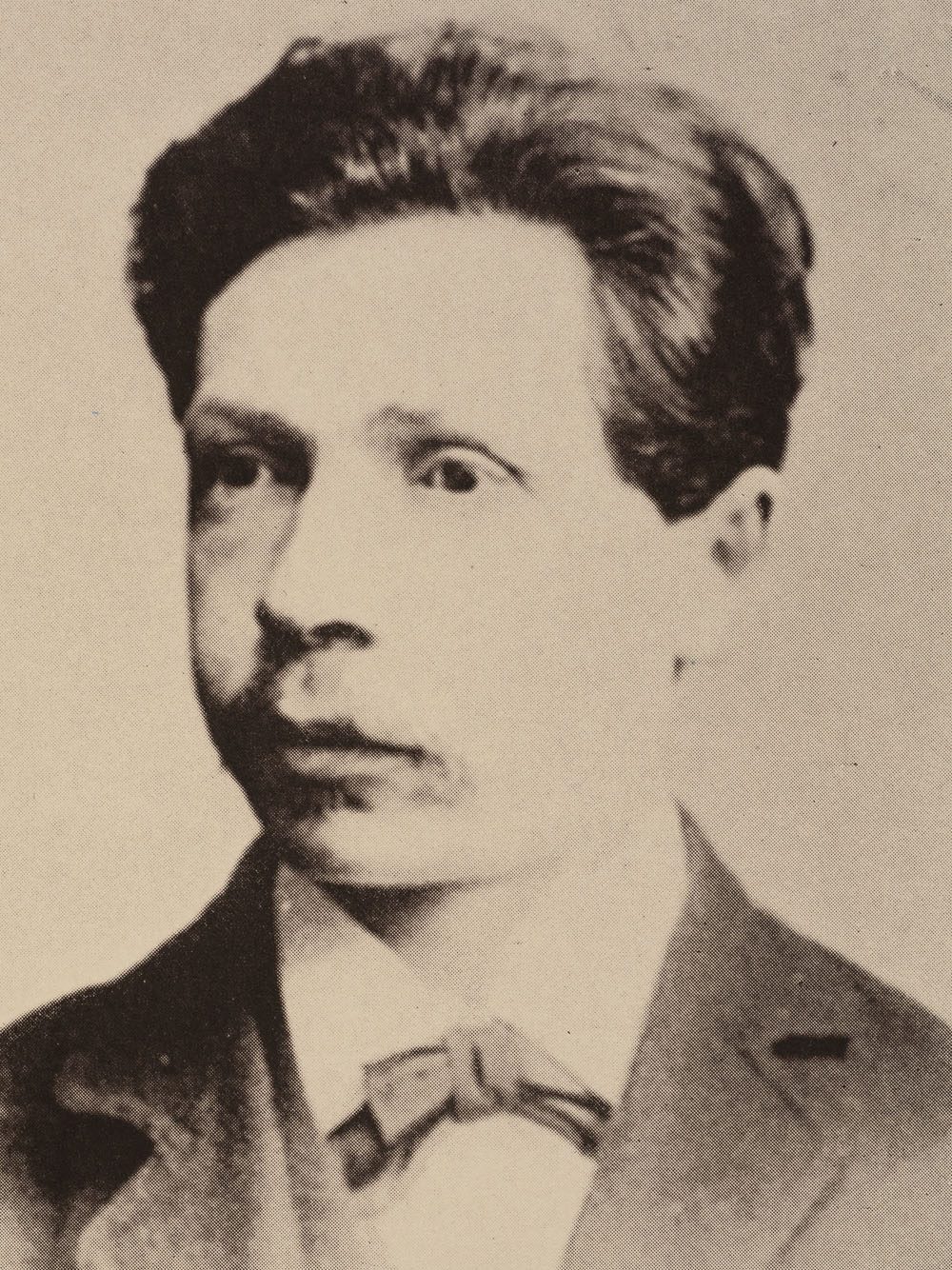
Morris Winchevsky (1856-1932) was born in Kovne (Kaunas), Lithuania. He moved to London in 1879, and between 1884 and 1894 he established and edited the earliest British Yiddish newspapers Der poylisher yidl (The Polish Jew), and Der arbayter fraynd (The Worker’s Friend). He wrote extensively as a satirist and a poet and was nicknamed the zeyde (grandfather) of Jewish socialism. The satirical sketch, Vi vert men a dikhter (How Do You Become a Poet) was published in the satirical column Der meshugener filozof (The Crazy Philosopher) and is full of local politics including the 1889 dockers’ strike. The column lasted for some decades, starting in Der arbayter fraynd and later in the Forverts newspaper in the United States.
I was always doubtful about the story of God appearing to King Solomon and asking him what he wanted. I know you shouldn’t blaspheme, but this story strikes me as a bit of a tall tale. I’d like to believe it but I don’t. All I can say is this: If God came to me today and asked me what I wanted, I’d only ask him to make me a poet… [read more]
Listen to the story in Yiddish below
‘London bay nakht’ (London at Night) (1885)
Morris Winchevsky, translated by Vivi Lachs
Much of Winchevsky’s poetry was set to music and sung in the streets as anthems for workers protesting against sweatshop conditions in the tailoring and other trades. ‘London bay nakht’ (London at Night) comes from a series of poems published in the 1880s and 1890s in the London Yiddish press and republished in 1910 in Lider un gedikhte (Songs and Poems) in a section entitled ‘Londoner siluetn’ (London Silhouettes).
Ir lempelekh, laternelekh,
Dertseylt mir vos bay nakht,
Zikh shteyendik un brenendik,
Ir tsaytnvayz batrakht…The lamps and streetlights
Tells us what happens at night.
They stand and burn
Observing over time… [read more]
The Cockney Yiddish Podcast is written and presented by Nadia Valman and Vivi Lachs
Produced by Natalie Steed at Rhubarb Rhubarb for Queen Mary University of London
Funded by the Arts and Humanities Research Council
Guests: Professor Ruth Livesey and Dr Sarah Glynn
Reader in English: Nick Cassenbaum
Reader in Yiddish: David Schneider
Featured story: Morris Winchevsky, ‘How Do You Become a Poet’, translated by Vivi Lachs, from East End Jews: Sketches from the London Yiddish Press (Wayne State University Press, 2025).
Featured songs:
- Klezmer Klub. ‘London bay nakht’. Words: Morris Winchevsky. Music: Vivi Lachs, 2024. http://www.klezmerklub.co.uk.
- ‘Mare Street, Hackney’ (1929) (Rego and Polikoff Strike Songs, 1983)
Theme music: Klezmer Klub, ‘Vaytshepl mayn vaytshepl’ (trad), and ‘Yiddisher Honga’ (trad). From the CD Whitechapel mayn Vaytshepl (Klub Records, 2009)
Website images:
- ‘Der zig fun di shnayder’ (Der bloffer, June 1912).
- ‘‘Morris Winchevsky’ 1880s. From Cahan, Bleter fun mayn lebn Vol. 3 (Forverts, 1926).
Podcast image: © Jeremy Richardson
 The Cockney Yiddish Podcast
Leave a Reply