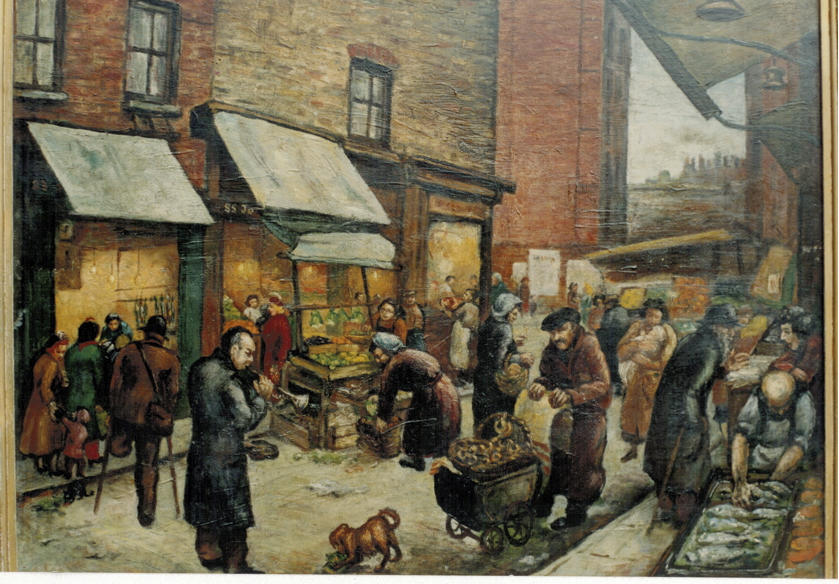
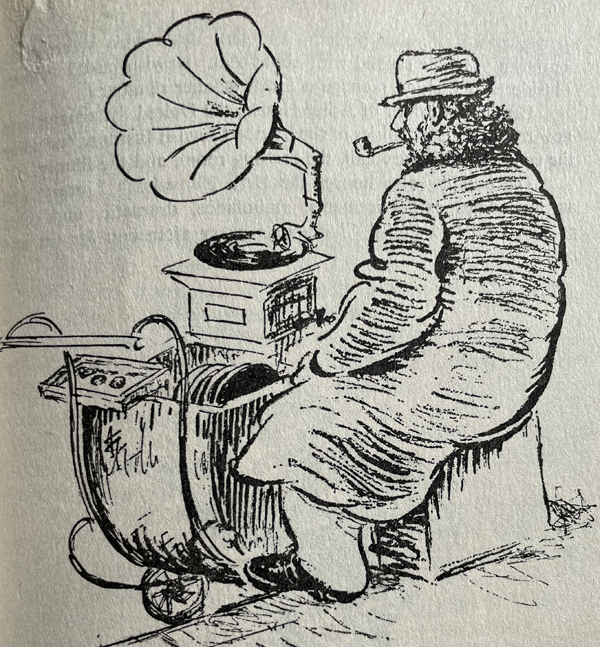
Who is the gramophone man? In the final episode of the series Nadia and Vivi go down an extraordinary rabbit-hole of East End history. They investigate the mysterious figure of Solomon Levy, immortalised in Yiddish East End street songs. But what is his connection with the ubiquitous gramophone man who haunted Petticoat Lane market with his clapped out gramophone on a rusty pram playing old Yiddish songs? This iconic figure featured in the famous 1955 film A Kid for Two Farthings as well as photographs, drawings and is our podcast image. What is fiction and what is real in the history of the Jewish East End? To help us answer this question, we invite broadcaster Alan Dein for an East End musical tour.
‘Petticoat Lane’ (Petikot leyn) (1956)
Moshe Domb, translated by Barry Smerin
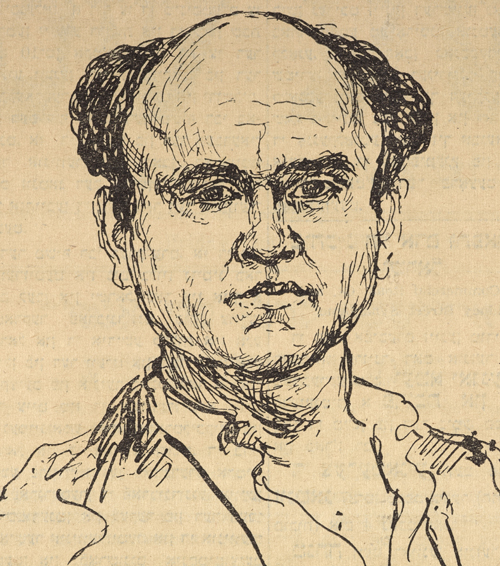
Moshe Domb (1910-?) was born in Chmielnik, Poland, and was the sole survivor of his family who were murdered in Treblinka. He arrived in London in 1950, where he wrote a novel about his wartime partisan life. He wrote occasional pieces for the literary journal Loshn un lebn and was active in the Friends of Yiddish group, where he read from his work.
Petticoat Lane. Most people who come to the Sunday market, including visitors from all over the world, don’t only come to buy; they also come for entertainment, like going to a film. So let’s try and capture it as if with a camera… [read more]
Listen to the story in Yiddish below
‘Old Solomon Levy’
Streetsong, translated by Vivi Lachs
This little ditty was remembered by many elderly Eastenders – each version slightly different to the next. When Vivi went round Jewish old age homes in London, singing the first words, “Old Solomon Levy”, there would be a chorus of tralala lalala la – even though most people knew no more of the song. But there are at least six London versions. The song is not the same tune as the 1885 Fred Seaver American song of the same name, but it is probably a parody of the chorus tralalala.
Old solomon levi, tralala lalala la
di mame gemakht di kliskes tralala lalala la
a froy mit finf kinder kukt aroys fun der vinder
un oy zi krekhtst un oy zi lakht
fun old solomon levi…Old Solomon Levy, tralala lalala la
The mother is making noodles, tralala lalala la
A woman with five children looks out the window
And oy she groans and laughs at old Solomon Levy… [read more]
The Cockney Yiddish Podcast is written and presented by Nadia Valman and Vivi Lachs
Produced by Natalie Steed at Rhubarb Rhubarb for Queen Mary University of London
Funded by the Arts and Humanities Research Council
Guest: Alan Dein
Contributors: Monty Bixer, Nat, Charles Fox, Sylvie Reid, Alice, Hannah Grant, Naomi, Emanuel Litvinoff
Reader in English: Miriam Margolyes
Reader in Yiddish: David Schneider
Featured story: Moshe Domb, ‘Petticoat Lane’, translated by Barry Smerin. From East End Jews: Sketches from the London Yiddish Press (Wayne State University Press, 2025).
Featured songs:
- Josef Rosenblatt, ‘Eili, Eili’. From Best Yiddish Songs (Victor Matrix, 1923)
- Klezmer Klub, ‘Old Solomon Levy’. From the CD Whitechapel mayn Vaytshepl (Klub Records, 2009)
- Mendel and his Mishpokhe Band, ‘A Kosher Fox Trot Medley (Petticoat Lane) Part 1 (1929). Digitised on the CD Music is the Most Beautiful Language in the World Yiddisher Jazz in London’s East End 1920s-1950s (Playloud, 2018)
Theme music: Klezmer Klub, ‘Vaytshepl mayn vaytshepl’ (trad) and ‘Yiddisher Honga’ (trad). From the CD Whitechapel mayn Vaytshepl (Klub Records, 2009)
Website images:
- Maurice Sochachewsky, ‘East End Market’ (courtesy of Dave Skye)
- Maurice Sochachewsky, ‘Moshe Domb’ (courtesy of Dave Skye)
- A. B. Levy ‘Curb-side [sic] Concert’. From Levy, East End Story (Vallentine Mitchell, 1951)
Podcast image: © Jeremy Richardson
3 responses to “Episode 7: The mystery of Solomon Levy”
-
I listened to all the podcasts and enjoyed them all very much. Thank you so much.
LikeLike
-
I came along to JW3 to hear your talk and have now listened to all 7 episodes.
Yes, I enjoyed them immensely, however, the inherited memories saddened me . . .Thanks for putting the series together, and I have sent the details to others for them to listen to and enjoy.
LikeLike
-
Very interesting podcast
LikeLike


 The Cockney Yiddish Podcast
Leave a Reply