How did London change the lives of Yiddish-speaking immigrants? How did the English language change Yiddish into Cockney Yiddish and how did Yiddish infiltrate Cockney English? Nadia and Vivi discuss how London’s English has changed over a century with linguist Professor Paul Kerswill. They follow the decline of East-End Yiddish through two generations and its re-emergence in the Yiddish revival today. They listen to a comic Yiddish music-hall song that describes how for new immigrants in the East End, the world felt turned upside down. They discuss a Yiddish story in translation, read by Miriam Margolyes, that tells of the rupture between a grandmother and granddaughter as they struggle to communicate.
‘A London Girl’s Secret’ (A sod fun a londoner meydl) (1933)
I.A. Lisky, translated by Barry Smerin

Yehudah Itamar (Summer) Lisky (1899-1989) was born in in Yezerne, Eastern Galicia (today Ozerna, Ukraine). He moved to London in 1930 and was active in left-wing circles and the communist branch of the Workers’ Circle Friendly Society. He wrote articles and short stories which were published in Di tsayt (The Jewish Times) and coedited Ovent nayes (The Jewish Evening News).
It was already long past the time when people are released from their daily work, and Grandma Leah’s eyes were ceaselessly searching for Sybil. And the more the hour hurriedly advanced towards night, the more worried Sybil’s grandmother became. Something frightened her: it was so late, and Sybil wasn’t home yet. She mused and brooded, until the noise of the city filled her head and her thoughts began to spin a dark web… [read more]
Listen to the story in Yiddish below
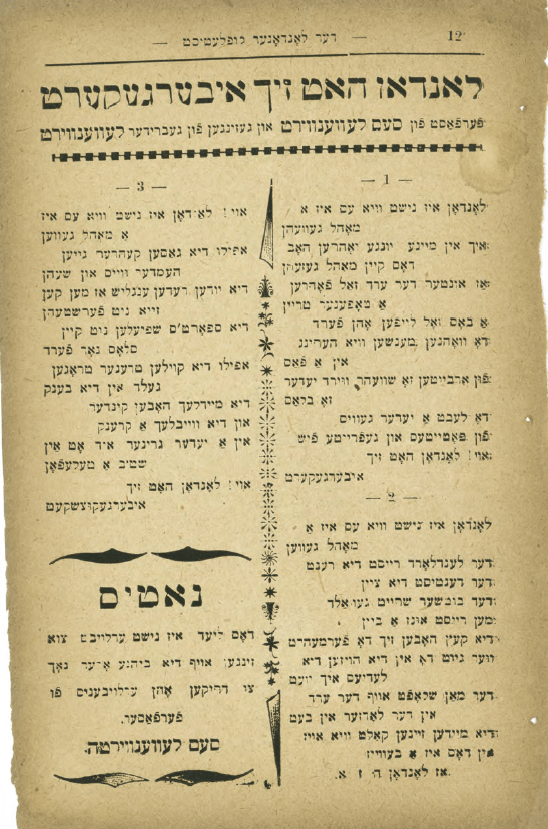
‘London hot zikh ibergekert’ (London is Turned Upside Down) (c. 1900)
Sam Levenvirt, translated by Vivi Lachs
Sam Levenvirt (1880-1954) was born in England and had child roles in the Yiddish theatre under the famous actor/theatre director Jacob Adler. He was from a theatre family and often performed with his brothers and sisters. Levenvirt later went to America but returned to perform in London’s Yiddish music-halls between 1907-9.
London iz nisht vi es iz amol geven.
Ikh in mayne yunge yorn hob dos keynmol gezen
az unter der erd zol forn a topener treyn –
a bus zol loyfn on ferd…London is not the same as it once was
In my young days I never saw anything like this.
That a tube train travels underground
And a bus runs without a horse… [read more]
The Cockney Yiddish Podcast is written and presented by Nadia Valman and Vivi Lachs
Produced by Natalie Steed at Rhubarb Rhubarb for Queen Mary University of London
Funded by the Arts and Humanities Research Council
Guest: Professor Paul Kerswill
Contributors: Katy, participants from the Holocaust Survivors Centre Yiddish group and the Yiddish Sof-vokh 2024: Divyam, Zack, Doris, Misha, Dawn and Irmiye. Extract from oral history interview with Heimi Lipschitz, courtesy of Jewish Museum London
Reader in English: Miriam Margolyes
Reader in Yiddish: Tamara Gleason Friedberg
Featured story: I A Lisky, ‘A London Girl’s Secret’, translated by Barry Smerin. From East End Jews: Sketches from the London Yiddish Press (Wayne State University Press, 2025)
Featured songs:
- Katsha’nes, ‘London hot zikh ibergekert’ (Lyrics: Sam Levenvirt. Music: Vivi Lachs). From the CD Don’t Ask Silly Questions (Katshanes, 2017).
- Great Yiddish Parade, ‘Der frayhaytsgayst’ (Ensemble Festival, 2024)
Theme music: Klezmer Klub, ‘Vaytshepl mayn vaytshepl’ (trad), and ‘Yiddisher Honga’ (trad). From the CD Whitechapel mayn Vaytshepl (Klub Records, 2009)
Website images:
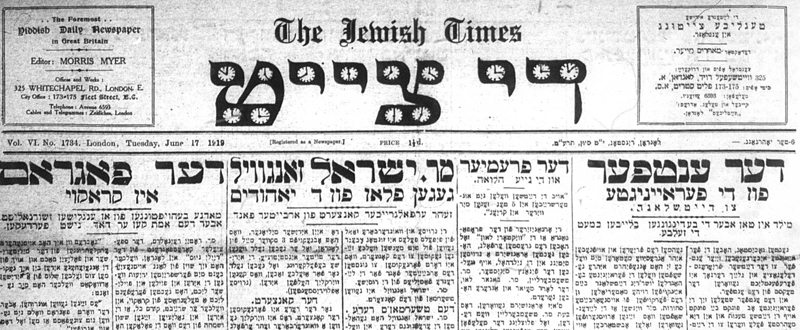
- Masthead of Di tsayt (Jewish Times, 1919)
- ‘Lisky’ (Drawing, courtesy of Francis Fuchs)
- Sam Levenvirt, ‘London hot zikh ibergekert’ (Londoner kupletist, c. 1903)
Podcast image: © Jeremy Richardson
8 responses to “Episode 1: Now you’re talking Cockney Yiddish”
-
-
My paternal grandfather John Sherman (Schermann) born in Antwerp 1904, came to London in 1914 with his parents and siblings. My great grandfather Isidore was a diamond merchant born in Lithuania who moved to Belgium. John married my grandmother who was not Jewish but they divorced after a short marriage (my father was only 4) and he sadly died aged only 43. My father kept in contact with his Jewish uncles and aunt in London. But I have little information about his father’s education and life in London. My father passed away in 2021. I have found photos and documents from my great grandparents in the Jewish museum in London. As my father was so young when his parents divorced he did not remember whether his Jewish relatives spoke Yiddish.
The podcast is moving and enthralling. I can imagine my Jewish heritage which I have always felt a connection with.
I joined the Suffolk Liberal Jewish Community two years ago.
Thank you for such a fascinating insight into Jewish LondonLikeLike
-
-
I hope you mention Schram and Schredel the Haberdashers shop in Islington.
Sadly closed down in the 1990s
LikeLike
-
Although a Scot I was born in Whitechapel. Both my grandfather and father had worked/trained at The London Hospital and that is where I returned to for my medical training in the 1960s. A large percentage of my medical student cohort were Jewish, even more so in the dental school, and many more patients. After qualifying in 1970 my wife and I lived at Mile End Hospital before moving to rented accommodation in Cavell Street where most of our neighbours were Jewish – salmon smokers, taxi drivers, in the shmutter trade – clothes factories were all around us. After a couple of years we moved to Somerset and thence to Tasmania, but my memories of the East End, and my student days in Maples Place with daily visits to the Whitechapel market and all the pubs, including the Watney Mann brewery, remain very fond.
LikeLike
-
This is a fascinating and important episode.
However, there were earlier Jewish fish shops opened by immigrants.My great-grandfather, Marks Maidart had come from Zychlin in Poland. In 1899 he had a fried fish shop at 35 Dean Street, Commercial Road, E. By 1901 he had sold the first shop, and had a fried fish shop at 80 Mulberry Street, Commercial Road East, E.
In 1904 Marks Maidart had opened a fried fish shop at 6 Coutts Road, Bow Common, E. In 1907, as well as this shop he had 125 Bridge Street, Bow. In 1909 he had another shop at 84 White Horse Street, Stepney, where he was trading as a fried fish dealer.
-
This lifted my spirits today. I liked the horseradish and beetroot story, I’ve been eating a Romanian homemade one and they pronounce it fren. I lit cigarettes for an observant man on a sabbath in hospital. Both sides of my grand parents and my great grandmother spoke yiddish, I just know a few words. I am 5 generation Londoner which started in the Jewish East End, great grandma born 1880s. I enjoyed the klezmer!
LikeLike
-
A wonderful effort to reproduce a way of living in bygone times.
As an 82-year-old Jew brought up in Hackney and attending cheder (Dalston Talmud Torah) five times a week, I was groomed to be a rabbi, but turned down this opportunity. One of my colleagues at Hebrew classes, someone who messed about constantly, became a rabbi, had 10 children and now lives in Israel.
I remain strictly kosher but rarely attend a synagogue. I recall the Jewish East End with great affection and I love Yiddish, with a host of words in my Yiddish vocabulary.
Many congratulations to everyone who hand a hand in producing this marvellous podcast.LikeLike


 The Cockney Yiddish Podcast
Leave a Reply to Saul Senders Cancel reply